|
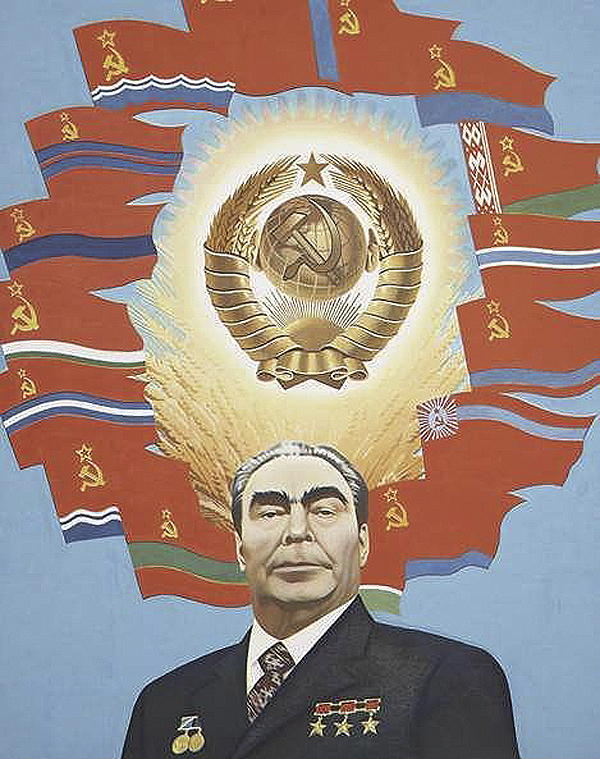
Erik Bulatov January 2012 Wikipedia What was your first work of contemporary art? Perhaps, artworks when I began to feel like an artist should be considered to be the first ones. They were still-lifes and landscapes, painted in 1963. Since that year I have considered myself an artist. What was of your own? It was my attitude to the space and the surface... In general, I realized that it was a painting. What was the first work of contemporary art you had seen? Everything’s relative. Painting by Falk, which I saw in the winter of 1952-1953, was the first that impressed and influenced upon me much. It was completely unusual and opposite to what I was educated. How do you think it is necessary to teach art skills? If you have an opportunity to draw and paint from nature every day during ten years, you should be a complete idiot, if you learn nothing. Even if a tutor were the worst one. The very opportunity gives a lot. The academic education is learning the trade. If you learn good and with diligence, you will be a skilled craftsman. It’s important, because otherwise you will suffer from inferiority complex and lack of skill. You will be able to draw a face, to make a study from nature. You will have basic art skills. But whether you can be a really good artist it is a question. I am not sure that it could be taught. Who do you consider to be your teachers? First of all, they are Falk, Favorsky. I am very obliged to them as teachers. I am also very thankful to Pyotr Dmitrievich Pokarzhevsky, my academic teacher. My first tutor was Alexander Mikhailovich Mikhailov, a teacher in the Pioneer House. And of cause, there were my friends in the art school, we learnt from each other. First of all, they were Oleg Vassiliev, Ilya Kabakov and Vsevolod Nekrasov Vassiliev and Kabakov were your classmates in the art school and in the art institute, weren’t they? Yes. Did you take lessons from Falk and Favorsky or did you just meet them? No, I didn’t take lessons. I visited Falk much. I watched, talked to him and even showed him my artworks. I didn’t show my artworks to Favorsky. We with Oleg Vassiliev called on Favorsky. We talked and asked him questions, and he answered. What authors and what artworks do you consider to be determinant for you? I become more interested in the classical art. I am more and more fascinated with the oeuvre of artists of the 15-18th centuries. I think that there are some stages, periods in the life of each person, of mine, in particular. Each period is related to a different name. They, the names, the artists, are changing. Who is at present? At present? You see, I don’t need the contemporary art at present. When I moved to New York and later to Europe, I rushed to see the contemporary artworks. It was interested, but, seemingly, anything that I could learn in the contemporary art I had learnt long ago. The matter is my personal work. Now I give back what I have received. As concerns the classical art, you can continue admiring it. There is always much to learn. There are many artists, i.e. Jan Vermeer, Rembrandt, Velázquez, Leonardo da Vinci, and others. Every year I visit Florence. I need it every year. I go there like to school. Naturally, I constantly attend the Louvre Museum to see specific artworks. These are works by Fra Angelico, Titian and others. Now my favorite artist is Fra Angelico What artist do you carry on a dialogue with? I don’t carry on a dialogue with any artist. But I am interested in the art of two contemporary artists. One of them is Ed Ruscha. He is an American artist; we have much in common. It is funny, but I have seen very little of his works. I’ve heard about him shortly before my departure for the USA. Only there I could see his art. Another one is Anselm Kiefer. They are two artists, whose oeuvres are interesting and close to me at present. Have you met them personally? No. I’ve met neither one, nor another. Do you collect works by other artists? No. I don’t want. I am no collector. But I have my friends’ gifts. I have works by Oleg Vassiliev, of cause. I appreciate him more than all other contemporary artists. His works are valuable for me. Are there artists, who you consider to be your antagonists in art? There are many of them. They are artists who concern themselves with other things. I am engaged in space and light. If I see that an artist is indifferent to it, I consider him to be my antagonist in art. And I don’t care what he is creating. Do you divide your art into any periods? Surely. The first stage started in 1963 and ended in 1964. Later there was a period of the «surface», then a period of the «space». My first works dealt with surfaces, in 1966 with the space. There were diagonal, horizontal, white, and black lines. Later I attempted to build a picture as a system of different spaces. It was the late 1960s. Since 1971, there appeared a painting, which included the space of the viewer and the space of the very picture. Surfaces of the canvases were a border between these two spaces. It was important that both spaces were included in the picture. The viewer became a participant rather than a bystander. He seemed to be a part of the picture. It was a turning point for me. In fact, it is a type of the artwork that I have been engaged with up till now. What are your political views? When I was a teenager, I was a staunch Komsomol member. But in 1950 I understood, that I witnessed terrible events. It was destruction of culture and art. I hated that political system. Up till now I am sure that the democratic system, like in Europe and the USA, is necessary in Russia. It is not ideal, but it is necessary. The present situation in Russia is disgusting, to my mind. In 1991, there was a period of illusions, hopes, but unfortunately everything went wrong. At the end of the last year, there started some changes. People started to protest against the things that were going on. At any rate, it held out some hope. That is all I can say. What is your attitude towards religion? I am an Orthodox Christian. But there is a difference between attitude to religion and attitude to the Church. Actions of the Russian Orthodox Church are awful. There is a danger that it will control art processes. It will be destruction. On the other hand, artists shall not provoke such things. They should be careful. If an artist protests against the church, it is natural and nobody has the right to prohibit him. But if an artist’s actions hurt religious feelings of other people, it is a different story. An artist should not touch upon religious issues. What events, happened on your memory, do you consider the most important? The first event was the war, of cause. It was the most terrible event of my life. It can’t be compared with anything. The best event in my life and in the life of Russia was Stalin’s death. Later there were many more or less important political events. During the Khrushchev Thaw there were many stupid things, but not only. I am very thankful to Khrushchev, because he made a report on the cult of Stalin’s personality, many prisoners were released and many issues could be discussed. Later it was the end of the Soviet power. It was the most remarkable event that changed my whole life. Then there was my first solo exhibition in Zürich, Switzerland. It was the main event in my artistic career. Then my previous life ended and a new life started. One of your most famous artworks is a portrait of Brezhnev... What do you think of him as a political leader? It was no portrait. The work was titled the Soviet Cosmos. I think that Brezhnev was a decorative, hollow figure. The Soviet system needed such leader. It continued to exist in itself and needed a person who didn’t disturb it. Reformers like Khrushchev were no good for this system. It rejected them. Brezhnev was an ideal leader. He was a simulated person, who looked like a God, but was null, in reality. I tried to convey the idea. What art movement do you belong to? How do you identify the movement? I have never ascribed my art to the Sots Art. The Sots Art deals with social problems. It asserts that there are no other issues. It turns concepts regarding to the Soviet consciousness, to the Soviet ideology. But it is just spinning inside the same circle. I have been always interested in finding a way out of limits of the social space. I consider that the meaning of a human life is out of the social space, it is out of limits. The meaning of art is also there. That is why, limits of the social space and problems of possibility or impossibility to go out of the limits have been important for me. The Sots artists have never been concerned with the issue. I am obliged to the Pop art, rather than to the Sots art. By the way, I appreciate the American Pop art. But I don’t feel the impact of any specific artist upon my art. The Pop art asserts that there is a whole world of objects, a circle of notions which surround us from our childhood. The main idea is to admit everything into the art. It is of a special meaning for the Russian artists, because we believe to live in a «fake» world. We have everything «false». We think that before the 1917 Revolution everything has been «real», the language has been «real»; the culture has been «real». At present we seem to speak the «incorrect» Russian language and to think «wrong». And we should be ashamed of what we are and we should try to be «real». Such opinion has resulted in false things, i.e. false intonation, false attitude. We are what we are and we should speak the language the way we speak about the problems which we have. My artwork titled I Live and I See is devoted to the problem. It is an opportunity to speak in my language what I think and how I understand it. The Pop art has rendered assistance in this case. It is remarkable in the Pop Art. But once again, there have been limitations. The Pop art declares that only the world of advertising, the world of TV is real. But I have never sympathized with it. I have never taken it seriously. Once again I have faced the problem how to go beyond the limits of the Pop art. I have primarily a different world-view. I don’t fit into it. My art has been ascribed to many movements, to photorealism, for example. But I can’t identify myself with any art movement. Perhaps, I have much in common with the Conceptual art. But the Conceptual art is also a difficult question. Its boundaries are much diffused. Did your art change after the end of the Soviet period? When the Soviet period finished, I was a mature artist. But the life changed, and the themes changed. I always dealt with topics which were provided by my own life. I didn’t touch upon the Soviet themes, after the Soviet Union had collapsed. Previously I was engaged with the social issues, the social limits of the social space. At present I am more interested in the existential problems. Are you interested in problems of the present social space with its ideology? It doesn’t concern me. But it is an important theme. If anybody does it, it will be right. I have tried to deal with it. I’ve made an artwork titled Our Time Has Come. It conveys my attitude to the events which occur at present. I understand the present time as an underpass from one epoch to another. We know the past epoch, but we don’t know the future one. Thus, I’ve tried to show this underpass. It is an actual Moscow landscape. It is an underpass under the Garden Ring near the Kursky railway station in Moscow. The exit is an upward stairs. Some people go one way; some of them go the other. There is a dark underpass in the foreground. There are words, written on the black background. People are just black silhouettes. The white letters write, Our Time Has Come. The words are addressed to the viewers. They are almost out of the picture. The matter is that it’s just such a time, such a time has come. What exhibitions that you have participated in do you consider the most important? I consider my solo exhibitions to be most important for me. The first one occurred in the Zurich Kunsthalle. It played the most important role in my life. Later there was an exhibition in the Georges Pompidou Centre in Paris. A good show took place in Hannover in 2006. The same year I exhibited my works in Moscow. It was my most considerable exhibition in Russia. Then the Musée d’Art moderne de la Ville de Paris hosted my artworks. What exhibitions that you have seen are the most memorable for you? One of them was an exhibition of Vermeer in Holland. There was a good exhibition of Yves Klein in the Pompidou Centre. I admire this artist. A perfect show of Anselm Kiefer occurred in the Hospital Chapel in Paris. To my mind, it was his best exposition. Later there was his display in the Grand Palais, Paris, but I didn’t like it. What is your favorite museum? Most of all, I love the Louvre at present. I liked the National Gallery in London and the Uffizi gallery in Florence. The galleries contain excellent artworks, but I don’t like the way they are exhibited there. There is a good museum of classical art in Berlin. In my childhood my favorite museum was, of cause, the Tretyakov Gallery. Who are your favorite Russian artists? Levitan, Savrasov. I also like many individual paintings. Which? I admire the Grandmother’s Garden and the Moscow Courtyard by Polenov. They are masterpieces. But I don’t like the rest of Polenov’s oeuvre. Alexander Ivanov, for example, is a very important figure in the 19th-century Russian art. Serov is also a celebrated artist. His Girl with Peaches and early paintings are exceptional. My most favorite artist has always been Vrubel. But I hate the way his artworks are exhibited in the Tretyakov Gallery. To my mind, it destroys them. There are wonderful works by Kuindzhi, Ge, Surikov, Repin, Vasnetsov and others. What is the peculiarity of the Russian art? I have written an article on the Russian art, where I try to explain the common features between Malevich and Levitan. What is the difference between the Russian art and the French, German art? When you look at an artwork by a German, Dutch, French or a Spanish artist, you immediately understand who the author is. It is a work by Rembrandt or by Velázquez. Thus, the first thing which is clearly evident is that it is a painting by a specific artist. Only then you notice what he has depicted. The Russian paintings are distinguished with the fact that the viewer immediately finds himself in a birch grove or in the crowd of the 17th-century Moscow street. You find yourself in the crowd. You don’t think about the painting, whether it is good or bad and who the author is. The goal of an artist is to immerse the viewer in the picture rather than to show his painting skills. The artist is not evident. He tries not to disturb the viewer staying in the birch grove. It is a very important moment. And what about Malevich? Curiously enough, Malevich is very close to it... Let’s have a look at the art of the 19th century. The matter is that a sort of devaluation of artistic means takes place. In Malevich’s art, this devaluation of artistic means reaches its climax. In fact, what does Malevich want to show? He says that we should change this world. We should change completely everything. We should reject objects which surround us. Absolute freedom waits for us. Our consciousness will change completely. We will find ourselves in a different world. We should only refuse the whole objective world and discover primary elements. It will give us freedom. It is so easy. And he has shown it. He offers the viewer all means. He declares that anyone can do this. It is an absolute devaluation of artistic means. He makes the viewer a co-author and withdraws himself. Unfortunately, people have allowed and still allow themselves to be fooled with the concept. Any fool can do it. But try and do it actually. |